
A household in extreme poverty usually lacks several things at once: money to start a business, the skills to run it, someone to advise it, and a safe way to save. Our theory of change is simple. Provide all four, in the right order and for long enough, and a household can build an income that lasts. As that income grows, the family eats better, children stay in school, and there is a buffer against the next shock.
The challenge
About eight in ten rural Liberians were poor in 2016, the latest year with national survey data. Most support that reaches them arrives as a single input: a training course, a one-off grant or a savings group. Each helps a little, but on its own it rarely moves a family out of extreme poverty for good.
Our Solution
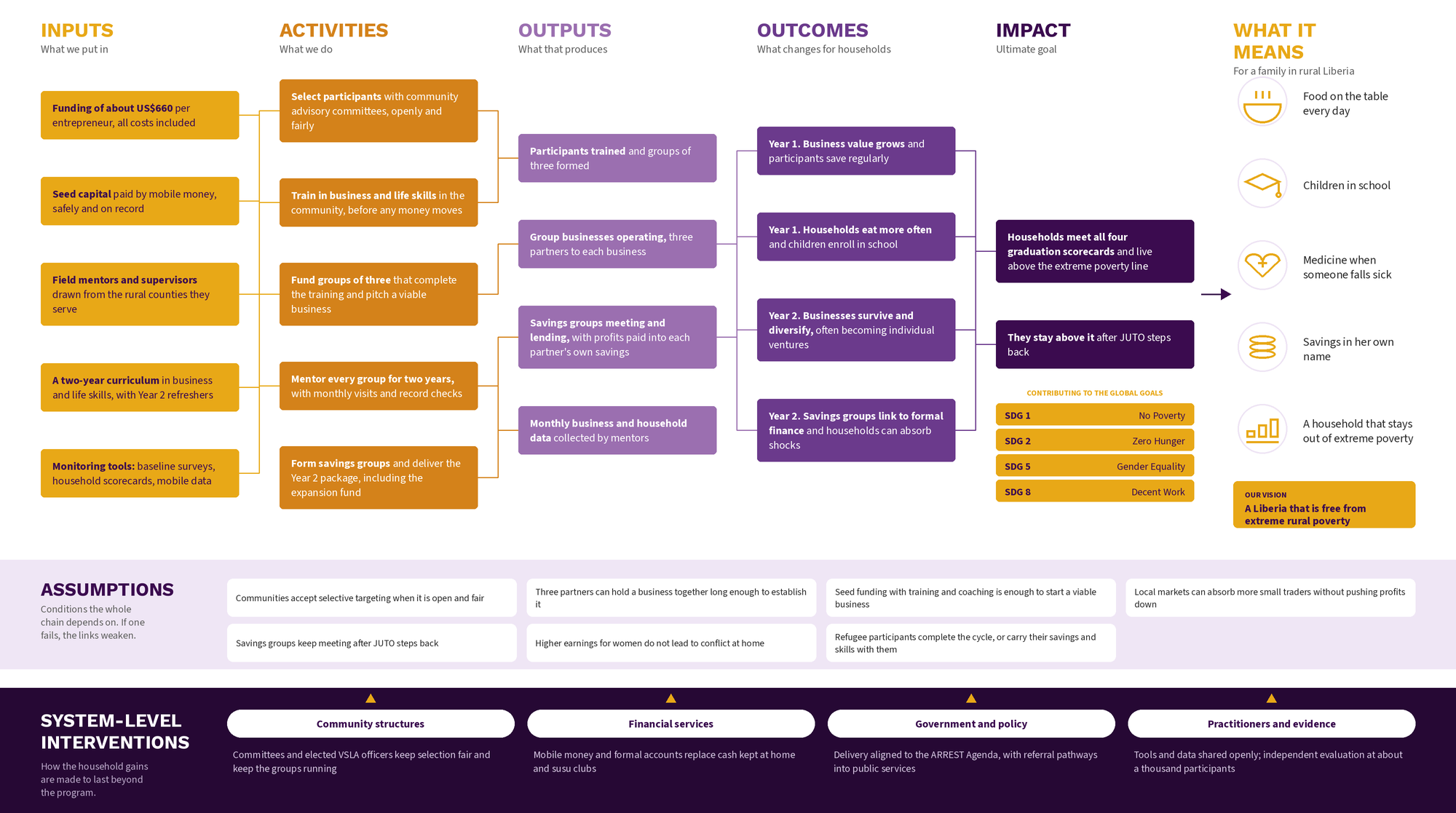
Guiding principles
- Deliver the pieces together, in order, and for long enough.
- Fund only those who complete training and pitch a viable business.
- Let entrepreneurs choose their own businesses.
- Spread risk through businesses of three partners, with savings in each woman’s own name.
- Judge success by the whole household, not just the business.
- Measure from day one and change course when the evidence says so.
- Build savings groups and community structures that can stand without JUTO.
- Work with government and other practitioners early.
Overall goal
A Liberia that is free from extreme rural poverty.
Strategic goal, 2027–2030
Fund 12,843 entrepreneurs across Liberia between 2027 and 2030, growing to 7,000 a year by 2030, and help their households graduate from extreme poverty and stay out of it.
Supporting goals
- Grow county by county, only when systems and staff are ready.
- Collect baseline, year-one, and graduation data for every cohort.
- Cost and fund the full two-year program, including the expansion fund.
- Include young people and refugees as well, with clear eligibility rules and protection safeguards.
- Strengthen our institutional system, core policies, and capacity.
- Build formal partnerships with government, UN agencies and other graduation practitioners.