How we measure progress
A program that plans to grow from 343 entrepreneurs in 2027 to 7,000 a year by 2030 needs to know quickly when something is not working. Our measurement system answers three questions: Is each household actually better off? Is the program being delivered as designed? How much of the change can we fairly claim? We are building it in stages alongside the program itself, and this page sets out what is in place, what is being built, and when each part arrives.
What our measurement system has to do
Tell us whether households are better off
Four household scorecards, plus income, measured at fixed points in every two-year cycle: food security, sustainable livelihood, shock preparedness, and human capital investment. This is what graduation means, and it is measured at the household level, not the business.
Tell us whether the program is being delivered as designed
Whether the training was completed and well taught, whether seed funding reached each group on time, whether mentors made their monthly visits, whether savings groups are meeting. When a cohort falls behind, this is the data that shows us where the delivery broke rather than only that the results disappointed.
Tell us how much of the change we can fairly claim
Households change for many reasons. A good harvest, a new road, a better year for prices. To say what JUTO caused, we need to compare funded entrepreneurs with similar households that did not receive funding, and in time to have that comparison made by people who do not work for us.
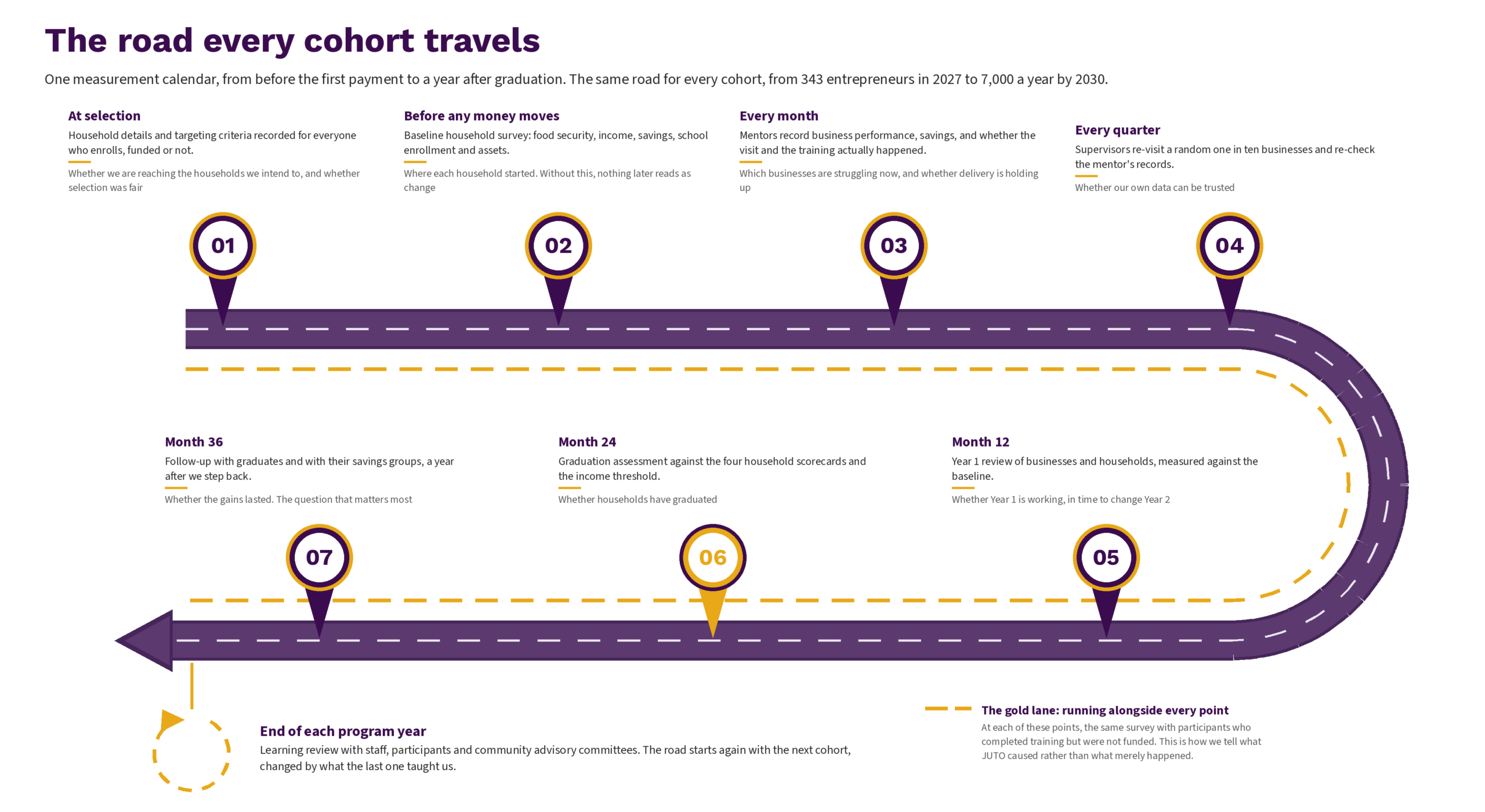
What we measure, and when
Every cohort follows the same measurement calendar, from before the first payment to a year after graduation.
How we handle data
Participants give informed consent before we collect their data, and again before we use their names, stories or photographs. Consent to take part in the program is never conditional on agreeing to appear in our materials. We store personal data securely, share it only when necessary, and take extra care with refugee participants, whose personal details can put them at risk. Our data protection policy sets out how long we keep information and who may see it.
Learning and changing course
A pilot is meant to teach. Ours ran for six months with individually owned businesses, and it showed us where the design had to change. Every row below is a change we have made to the program.
Pilot results at a glance
Six-month pilot, Bong County, 17 November 2023 to about May 2024, individually owned businesses.
Outputs
women reached
enrolled in training
entrepreneur funded
savings groups formed
mentors in the field
people directly benefited
average seed funding per business
Outcomes
%
businesses trading after the pilot
%
on track for growth at month 6
%
grew business value more then 25% above the grant
%
had more than one income
%
met the monthly savings target
saved by the three groups at month 6
lent to members from saving group
average business value at month 6
%
of households ate two meals a day
%
had no child go without a meal
%