Growing with partners
Nearly half the people in sub-Saharan Africa live below the extreme poverty line of US$3.00 a day, and the World Bank expects more than three-quarters of the world’s extreme poor to be living in this region or in conflict-affected countries by 2025. Liberia carries its share. When the country last ran a full household survey, in 2016, 71.6% of rural Liberians lived below the national poverty line, and the World Bank’s 2023 assessment put the figure closer to eight in ten.
Our pilot funded 50 women in Bong County. Our plan for 2027 to 2030 would fund 12,843 entrepreneurs across Liberia. Set against the need, that is still a small number. No single organization is going to end rural poverty in this country, and we have never pretended otherwise. What we can do is run a program that works, cost it honestly, measure it properly, and put what we learn in the hands of anyone else working towards the same end.
So we are looking for partners: funders who will back a cohort, practitioners who will challenge and sharpen our design, government partners who can carry parts of this work further than we can, and researchers who will test whether our results hold.
Our growth trajectory, 2027 to 2030
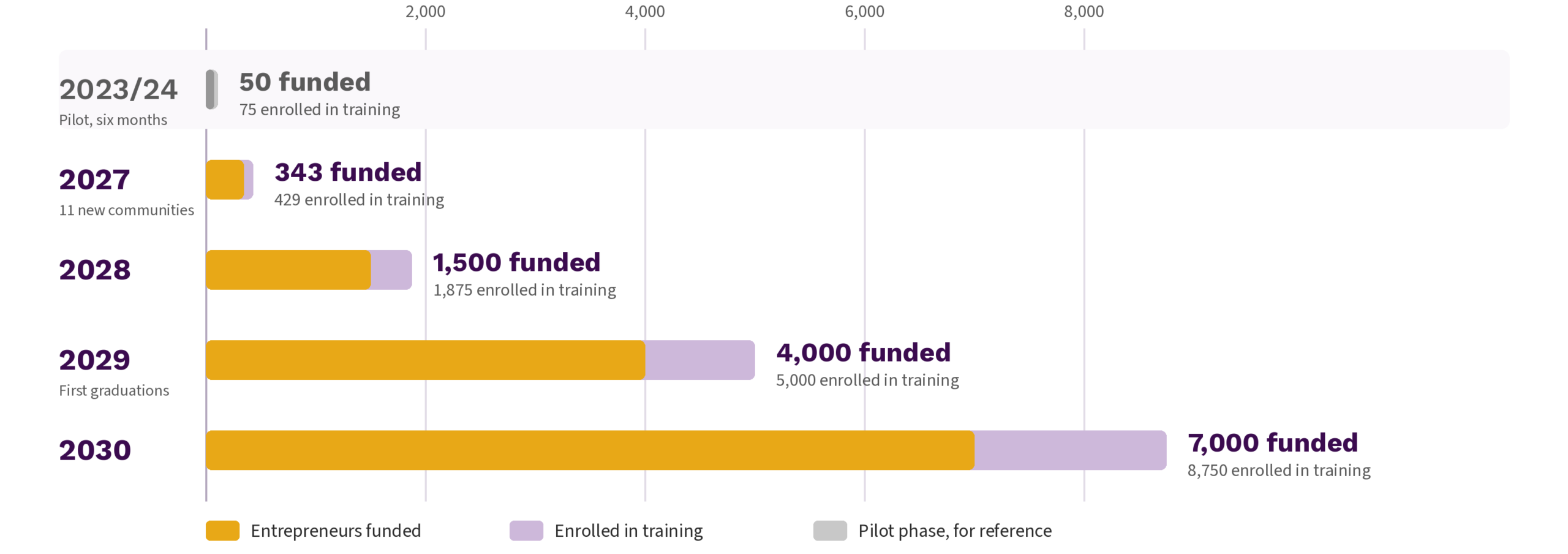
entrepreneurs funded, 2027 to 2030
businesses, each run by three partners
people reached in their households
Why partner with JUTO
- Liberian-led and close to the communities we serve: JUTO is registered and accredited in Liberia, based in Gbarnga, and led by a qualified team. Our mentors come from, have lived in, or have worked in the rural counties they serve. During the pilot they visited every business every month, in three core communities and seven surrounding ones, on roads that are hard to use for half the year. That is not a detail of delivery. It is the reason we know which businesses were struggling in month four and why, and it is what an international partner cannot buy in from outside.
- We build on evidence, and we change course when it tells us to: Our program is adapted from the BOMA Project’s Rural Entrepreneur Access Project, and it follows the graduation approach that BRAC has run in Liberia, including in Gbarnga. We did not simply copy it. Our own six-month pilot showed us where our first design fell short, and we rebuilt the program around what we found: two years instead of six months, businesses run by three partners instead of one woman carrying all the risk, an expansion fund in the second year, and graduation judged on four household scorecards rather than on business value alone. Every one of those changes cost us the comfort of reporting a finished model. We would make them again.
- We are careful with money: The pilot cost US$32,998 in total, and about 73% of that went to seed funding, training and operations. Every entrepreneur we funded cost about US$660, all costs included, and about US$300 of it reached her directly as seed funding paid through mobile money. We are now costing the full two-year cycle line by line, and we will publish that figure rather than quote the pilot rate as though it still applies.
- We say what we do not yet know: Fifty funded entrepreneurs is enough to show that the program can run in rural Liberia. It is not enough to prove impact. We had no comparison group, our own team collected the figures, and the pilot tested a six-month program with individually owned businesses, not the two-year group model we run now. The two-year model has not yet completed a single cohort. We are building baseline surveys, household scorecards and follow-up visits into every cohort from 2027 so that the next set of results can be judged on something firmer than our word.
- We expect to adapt, and we expect to be corrected: A model that worked for pastoralist women in northern Kenya had to change to work for farming and trading households in Bong County. It will change again for young people, for refugee families, and for counties whose markets and roads are nothing like Bong’s. We would rather design those adaptations with partners who know those populations than guess at them alone, and we would rather hear early that something is not working than defend it politely for two years.
Partner type
How we work together
Funders
Fund a cohort, the Year 2 expansion fund, or the systems we need to grow, such as tech tools, staff transport and data collection tools.
Graduation and livelihoods practitioners
Share tools and lessons, review our approach and explore joint programs.
Government
Align with national and county priorities, set up referral pathways and, over time, share responsibility for sustaining the program
Financial service providers
Mobile money for secure payments, personal savings accounts, and a path from savings groups to formal finance
Youth and refugee organizations
Referrals, protection advice and co-funding for participants we are newly including.
Research partners
Help us measure results independently
Communities
Community advisory committees, local leaders and savings group officers help with fair selection, trust and problem-solving
Where we work
JUTO works in Liberia, on the west coast of Sub-Saharan Africa. Our head office is situated on Ganta Highway Street in Gbarnga City, Bong County, the country’s third most populous county, with about 467,500 people at the 2022 census. Our pilot ran in three core communities and seven surrounding catchment communities in Bong County. In 2027, we plan to expand into 11 new communities.
We choose new areas carefully. We look for high rural poverty, communities whose leaders are ready to form an advisory committee, a weekly market within reach, mobile money coverage, and places our field supervisors can reach regularly. We also avoid areas where another graduation program is already working.